For the English translation please scroll down the page, thank you !
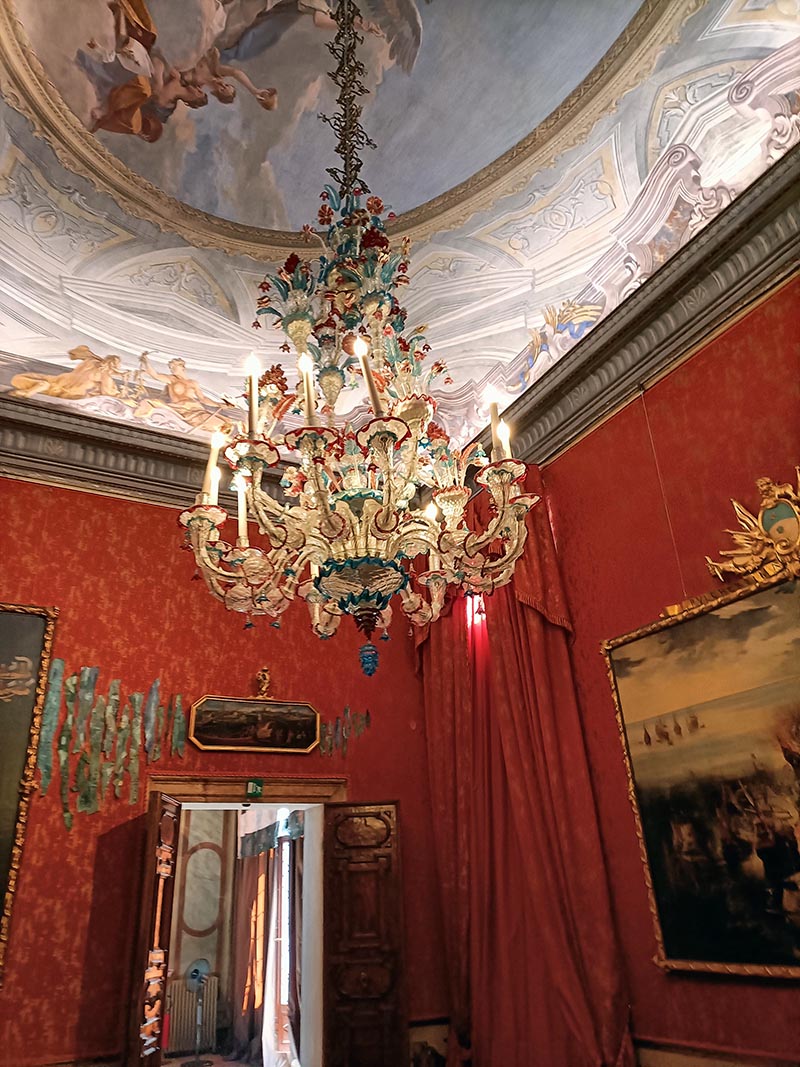 |  |  |
Nel stupendo Museo di Palazzo Mocenigo, e nel meraviglioso Museo di Ca’ Rezzonico, entrambi della Fondazione Musei Civici di Venezia, al suo interno, in molte sale, ci sono dei lampadari che sono a dir poco dei veri capolavori di arte vetraria. Volete saperne un po’ di più ?
La loro storia, inizia più o meno quando, nel 1291 un decreto della Serenissima ordinò che tutte le Vetrerie di Venezia, per evitare il rischio di incendi, fossero trasferite nella vicina isola di Murano. A quella data si fa risalire l’inizio della leggendaria attività vetraria muranese e da allora l’arte del vetro resterà indissolubilmente legata al nome di Murano. Dalle “murrine” alla “filigrana”, ai “reticelli”, ai calici soffiati che sono espressione dell’arte muranese del 400 e del ‘500, attraverso l’esuberanza barocca, la breve fioritura neoclassica e i “revivals” dell’800, si sviluppa questa lunga e affascinante storia. Ai giorni nostri vengono ancora riprodotte le opere più significative delle varie epoche, mentre lo spirito creativo della tradizione dà impulso alla ricerca di nuove forme che sono espressione del nostro tempo.
Si dice che i lampadari più belli di questi due musei, siano quelli di Briati, specialmente il modello Rezzonico: è un lampadario a sospensione in vetro di Murano realizzato a mano. È caratterizzato da una forma a cascata, con una serie di pendenti in vetro di Murano che si irradiano da un centro centrale. I pendenti sono realizzati in una varietà di colori e forme, e possono essere personalizzati per adattarsi a qualsiasi ambiente.
Briati fu una figura di spicco nella vetreria artistica veneziana del Settecento. Fu un abile maestro vetraio che sostenne con originalità le prerogative della tradizione muranese, contrastando l’invadente concorrenza del neonato cristallo di Boemia. Briati introdusse un nuovo tipo di vetro “uso cristallo” e inventò nuove tecniche decorative, che gli permisero di creare manufatti in vetro di grande bellezza e raffinatezza. Nel 1739 Briati aprì a Venezia una vetreria nella quale realizzò una varietà di manufatti in vetro, tra cui specchi, lampadari e altri oggetti in vetro decorato. La sua produzione fu vastissima e varia, spaziando dalle cornici ai lampadari (quelli detti “a pagoda” o “alla cinese”, con bracci decorati con fiori policromi), dalle lampade da parete (dette “lumiere” che diverranno l’incontrastata specialità della vetreria veneziana dell’epoca) alle suppellettili da tavola. Moltissimi degli oggetti da lui creati sono ora conservati presso il Museo del vetro di Murano. Briati è considerato uno dei più importanti maestri vetrai del Settecento veneziano. Il suo lavoro ha contribuito a preservare la tradizione muranese e a diffondere il vetro di Murano in tutto il mondo.
Che altro dire ? Io vi consiglio di andare a vederli , nei musei che vi ho accennato sopra: Ca’ Rezzonico e Palazzo Mocenigo . Vi aspettiamo !!
The most beautiful chandeliers of the Civic Museums Foundation of Venice
| | |
In the stupendous Museum of Palazzo Mocenigo, and in the marvelous Museum of Ca’ Rezzonico, both of the Civic Museums Foundation of Venice, inside, in many rooms, there are chandeliers which are nothing short of true masterpieces of glass art. Do you want to know a little more?
Their story begins more or less when, in 1291, a decree of the Serenissima ordered that all the Glassworks of Venice, to avoid the risk of fires, be transferred to the nearby island of Murano. The beginning of the legendary Murano glassmaking activity dates back to that date and since then the art of glass will remain inextricably linked to the name of Murano. From the “murrine” to the “filigree”, to the “reticelli”, to the blown goblets which are an expression of the Murano art of the 1400s and 1500s, through the Baroque exuberance, the brief neoclassical flowering and the “revivals” of the 19th century, develops this long and fascinating story. Nowadays the most significant works of the various eras are still reproduced, while the creative spirit of tradition gives impetus to the search for new forms that are an expression of our time.
It is said that the most beautiful chandeliers in these two museums are those of Briati, especially the Rezzonico model: it is a handmade Murano glass suspension chandelier. It features a cascading shape, with a series of Murano glass pendants radiating from a central center. The pendants are made in a variety of colors and shapes, and can be customized to fit any setting.
Briati was a leading figure in eighteenth-century Venetian artistic glassmaking. He was a skilled master glassmaker who supported the prerogatives of the Murano tradition with originality, contrasting the invasive competition of the newborn Bohemian crystal. Briati introduced a new type of glass “using crystal” and invented new decorative techniques, which allowed him to create glass objects of great beauty and refinement. In 1739 Briati opened a glass factory in Venice in which he created a variety of glass artefacts, including mirrors, chandeliers and other decorated glass objects. Its production was vast and varied, ranging from frames to chandeliers (those called “pagoda” or “Chinese-style”, with arms decorated with polychrome flowers), from wall lamps (called “lumiere” which would become the undisputed specialty of Venetian glassware of the time) to table furnishings. Many of the objects he created are now kept in the Murano Glass Museum. Briati is considered one of the most important glass masters of eighteenth-century Venice. His work has helped to preserve the Murano tradition and to spread Murano glass all over the world.
What else to say? I advise you to go and see them in the museums I mentioned above: Ca’ Rezzonico and Palazzo Mocenigo. We are waiting for you !!


















 Diario di un operatore museale