For the English translation, please scroll down the page thank you !
Nel silenzio di “Le tarbouche”: la donna, il corpo e la solitudine nei dipinti di Mouna Rebeiz
Ci sono opere che si limitano a essere guardate. E poi ce ne sono altre che sembrano osservarti mentre le contempli, costringendoti a entrare lentamente dentro il loro silenzio. È questa la sensazione che ho provato davanti ai dipinti di Mouna Rebeiz, raccolti sotto il titolo Le tarbouche – Quando un accessorio diventa simbolo. Un ciclo pittorico in cui il corpo femminile diventa memoria, ferita, isolamento, ma anche possibilità di rinascita.
Parlando personalmente con l’artista, ho scoperto un dettaglio fondamentale: la figura femminile che attraversa quasi tutte queste tele appartiene alla stessa modella: Rana Karam, nipote dell’artista. Non una semplice presenza scenica, ma una vera musa ispiratrice. Mouna Rebeiz mi ha raccontato che quel corpo rappresentava perfettamente ciò che desiderava esprimere. Le linee morbide della schiena, le posture raccolte, quasi fetali, la capacità di trasmettere fragilità senza perdere eleganza: tutto contribuiva a dare forma visiva a un universo interiore fatto di solitudine e sospensione emotiva. Eppure, conoscendo la modella di persona, si comprende subito quanto sarebbe riduttivo fermarsi all’aspetto estetico. Certo, la sua bellezza colpisce immediatamente, ma ciò che resta davvero impresso è altro: la sensibilità con cui parla, la sua cultura, l’intelligenza quieta che emerge nei discorsi, una delicatezza rara che sembra riflettersi inconsapevolmente anche nei dipinti. Forse è proprio questa profondità umana ad aver reso possibile un dialogo così intenso tra artista e musa.
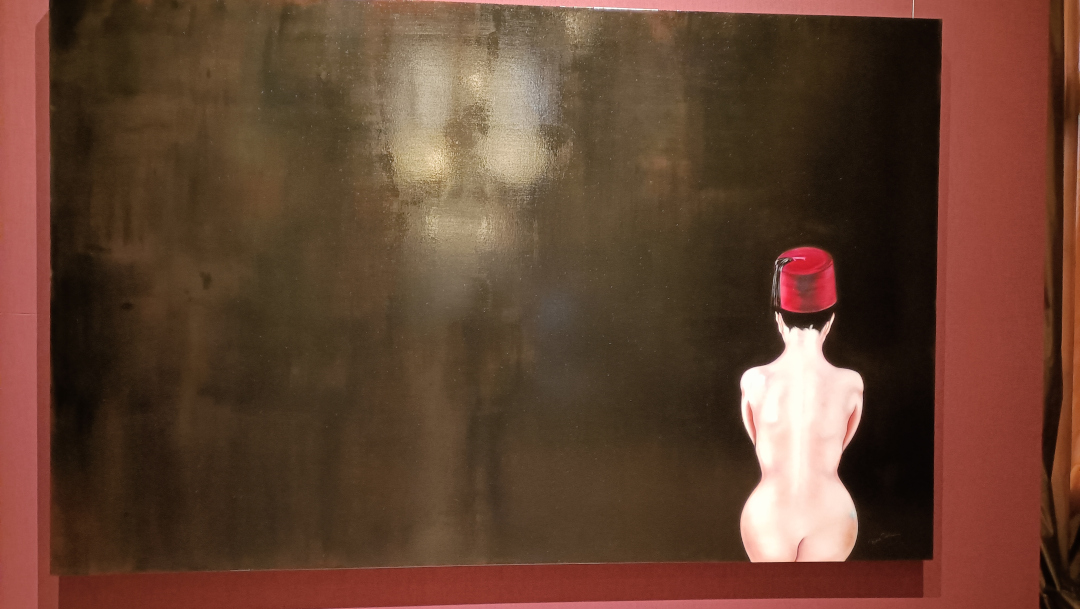
Nelle opere della serie, la donna appare quasi sempre di spalle, isolata dentro fondi monocromatici immensi, schiacciata da spazi che sembrano divorare lentamente la figura. In Le tarbouche (2014), il nero si espande come un vuoto cosmico: la protagonista sembra perdersi dentro un’oscurità che non è soltanto fisica, ma esistenziale. la figura femminile è relegata in un angolo della tela, quasi inghiottita dall’immenso vuoto nero che la circonda. Quel nero non è soltanto uno sfondo: diventa la rappresentazione visiva dell’abbandono, del silenzio e della mancanza di sostegno. La donna appare isolata, fragile, ridotta a una presenza minima davanti a uno spazio oscuro e sconfinato che sembra volerla cancellare. Il dipinto richiama con forza una condizione che, purtroppo, molte donne vivono ancora oggi, soprattutto nei casi di violenza domestica. Spesso chi subisce violenza si ritrova confinata in una solitudine emotiva e psicologica profonda, invisibile agli occhi degli altri, privata di ascolto, protezione e comprensione. Il vuoto nero che avvolge la figura può quindi essere letto come la metafora di una società che troppo spesso lascia le donne sole dentro il proprio dolore. Il tarbouche che porta sul capo diventa allora un segno simbolico, un fragile messaggio di speranza e di emancipazione femminile. Nonostante questa oscurità soffocante, la figura non scompare del tutto. Il suo corpo continua a esistere, a resistere. Il tarbouche che porta sul capo diventa allora un simbolo sottile ma potente di dignità, resilienza e speranza: il segno della possibilità di ritrovare sé stesse e liberarsi da quella condizione di isolamento.
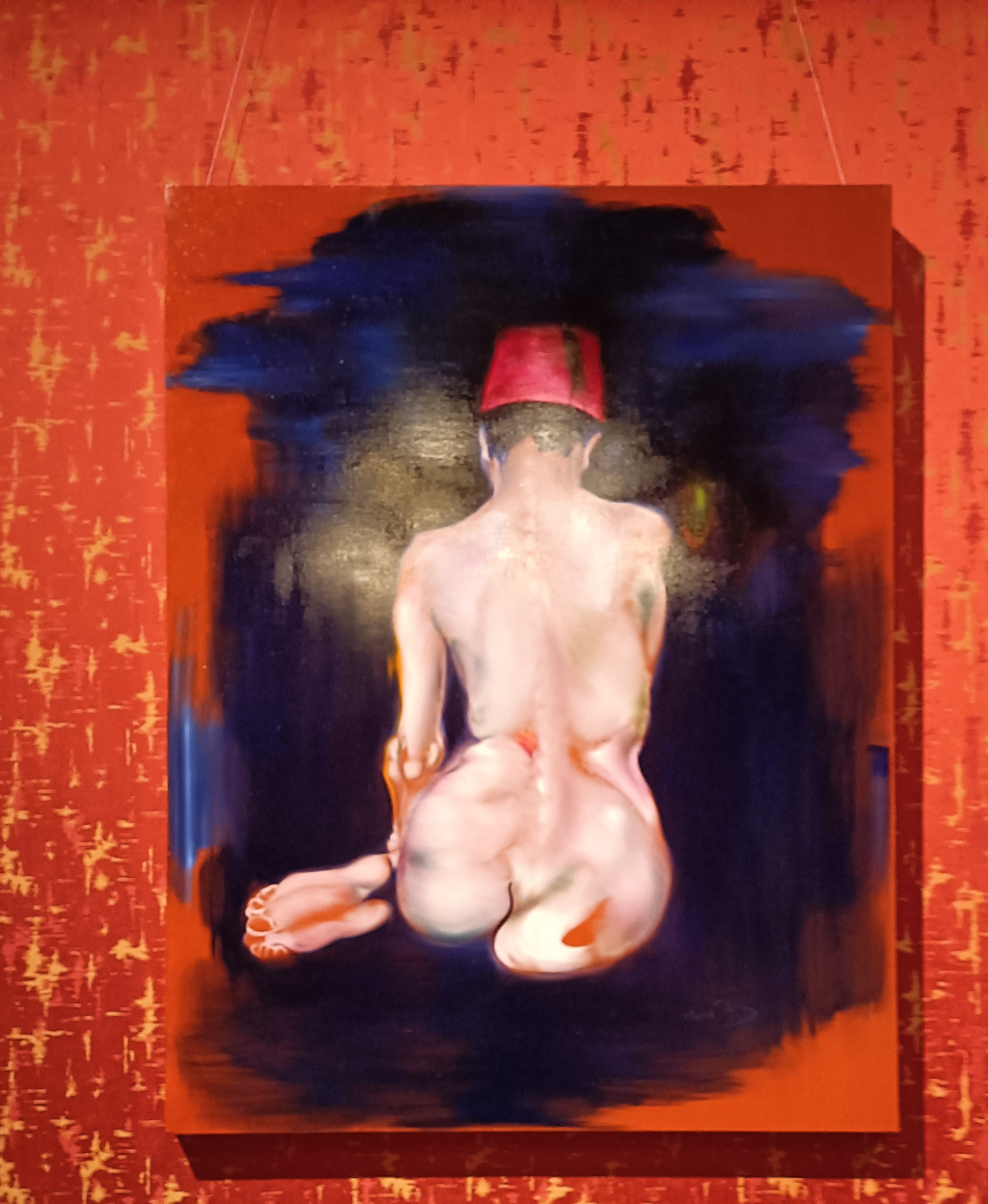
Anche in Exil, la figura si chiude su sé stessa. Il corpo reclinato in avanti richiama una posizione fetale, quasi un desiderio di ritorno a uno spazio protetto, lontano dalla violenza del mondo esterno.
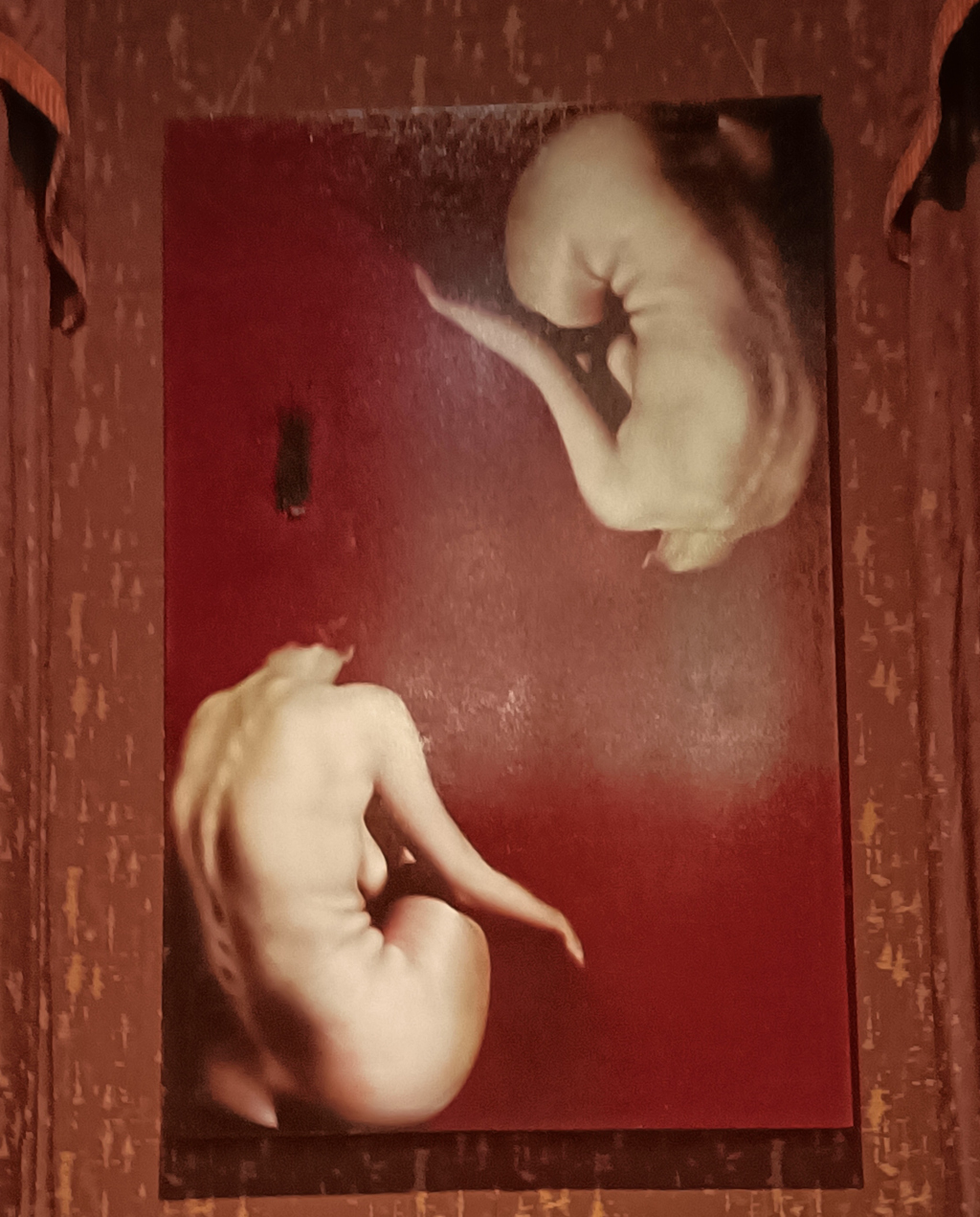
Ma è forse davanti a Red wine che il linguaggio simbolico dell’artista raggiunge una delle sue espressioni più potenti. La tela è attraversata da un rosso intenso, denso, quasi materico. Il colore non si limita a riempire lo spazio: sembra colare, respirare, diventare sostanza viva. Sangue, vino, carne, memoria. Osservando quest’opera, ho pensato immediatamente alla pittrice Elisabetta Rogai, https://diariodiunoperatoremuseale.co/2024/07/31/elisabetta-rogai-a-ca-sagredo/ celebre per l’uso del vino come materiale pittorico nelle sue enoarte. Anche nelle opere di Rogai il vino smette di essere semplice bevanda per trasformarsi in corpo, tempo, trasformazione organica. Il colore muta, ossida, invecchia, proprio come le emozioni umane. Nel caso di Mouna Rebeiz, però, il vino sembra assumere una dimensione ancora più interiore: non è soltanto materia, ma una sorta di liquido emotivo che avvolge e ingloba le figure femminili. Le due donne presenti nella composizione — una quasi speculare all’altra — appaiono sospese in uno spazio senza gravità, come ricordi che galleggiano nella coscienza. La pittura diventa allora pelle. Diventa tessuto. Diventa vulnerabilità.
E forse è proprio questa la forza più autentica della serie Le tarbouche: riuscire a raccontare la condizione femminile senza retorica, attraverso corpi silenziosi che parlano più di qualsiasi dichiarazione esplicita. Dietro quelle figure nude non c’è mai esibizione. C’è piuttosto un senso di attesa. Di malinconia. Di resistenza. Ed è impossibile uscire da questa mostra senza portarsi addosso almeno una parte di quel silenzio.
Invito tutta la cittadinanza e i turisti presenti a Venezia per le loro vacanze, di visitare il Museo di Palazzo Mocenigo, per poter apprezzare questa stupenda mostra. Non ve ne pentirete ! Vi aspettiamo !
In the Silence of “Le tarbouche”: Women, the Body, and Solitude in the Paintings of Mouna Rebeiz
There are artworks that simply ask to be looked at. And then there are others that seem to look back at you, slowly drawing you into their silence. That is the feeling I experienced while standing before the paintings of Mouna Rebeiz, gathered under the title Le tarbouche – When an Accessory Becomes a Symbol. A pictorial series in which the female body becomes memory, wound, isolation, but also the possibility of rebirth.
Speaking personally with the artist, I discovered a fundamental detail: the female figure appearing throughout some of these canvases is always the same model: Rana Karam, niece of the artist. Not merely a recurring presence, but a true muse. Mouna Rebeiz told me that this woman’s body perfectly embodied what she wished to express. The soft lines of her back, the almost fetal postures, the ability to convey fragility without ever losing elegance — all of it helped shape a visual universe suspended between loneliness and emotional vulnerability. And yet, after meeting the model in person, it became immediately clear how limiting it would be to speak only of her beauty. Of course, her physical presence is striking, but what remains with you is something deeper: her sensitivity, her culture, the quiet intelligence that emerges in conversation, and a rare delicacy that seems unconsciously reflected in the paintings themselves. Perhaps it is precisely this human depth that made such an intense dialogue between artist and muse possible.
In the works in the series, the woman almost always appears from behind, isolated within immense monochromatic backgrounds, crushed by spaces that seem to slowly devour the figure. In Le tarbouche (2014), the black expands like a cosmic void: the protagonist seems to be lost in a darkness that is not only physical, but existential. The female figure is relegated to a corner of the canvas, almost swallowed up by the immense black void that surrounds her. That black is not merely a backdrop: it becomes the visual representation of abandonment, silence, and lack of support. The woman appears isolated, fragile, reduced to a minimal presence before a dark and boundless space that seems to want to erase her. The painting forcefully recalls a condition that, unfortunately, many women still experience today, especially in cases of domestic violence. Often, those who suffer violence find themselves confined in a profound emotional and psychological solitude, invisible to the eyes of others, deprived of listening, protection, and understanding. The black void that envelops the figure can therefore be read as a metaphor for a society that too often leaves women alone in their pain. The tarbouche she wears on her head thus becomes a symbolic sign, a fragile message of hope and female emancipation. Despite this suffocating darkness, the figure does not disappear entirely. Her body continues to exist, to resist. The tarbouche she wears on her head thus becomes a subtle yet powerful symbol of dignity, resilience, and hope: a sign of the possibility of rediscovering oneself and freeing oneself from that state of isolation.
In Exil, the figure folds inward upon herself. Her body leans forward in a fetal-like posture, evoking a longing to return to a protected space, far from the violence of the outside world.
But perhaps it is in Red wine that the artist’s symbolic language reaches one of its most powerful expressions. The canvas is immersed in a deep, dense red that feels almost tactile. The color does not simply fill the space: it seems to flow, breathe, and become a living substance. Blood, wine, flesh, memory. While observing this work, I immediately thought of Elisabetta Rogai, https://diariodiunoperatoremuseale.co/2024/07/31/elisabetta-rogai-a-ca-sagredo/ the artist renowned for using wine itself as a painting medium in her celebrated enoart. In Rogai’s work, wine ceases to be merely a beverage and becomes body, time, and organic transformation. The color changes, oxidizes, ages — much like human emotions. In Mouna Rebeiz’s paintings, however, wine appears to take on an even more intimate dimension: it is not simply matter, but a kind of emotional fluid enveloping the female figures. The two women within the composition — one almost mirroring the other — seem suspended in a gravityless space, like memories floating within consciousness itself. Painting becomes skin.
Becomes fabric. Becomes vulnerability.
And perhaps this is the true strength of the Le tarbouche series: its ability to portray the female condition without rhetoric, through silent bodies that speak more powerfully than any explicit statement ever could. Behind these nude figures there is never exhibitionism. There is waiting instead. Melancholy. Resistance. And it is impossible to leave these works behind without carrying at least a fragment of their silence with you.
I invite all residents and tourists visiting Venice for their holidays to visit the Mocenigo Palace Museum and appreciate this wonderful exhibition. You won’t regret it! We look forward to seeing you!

