Il seguente articolo è scritto in Italiano, Inglese e francese, per le traduzioni scorrere la pagina
The following article is written in Italian, English and French, for translations scroll down the page
L’article suivant est écrit en italien, anglais et français, pour les traductions, faites défiler la page vers le bas

Venezia risorge nell’arte: Galeries Bartoux, Dalí e l’ex Cinema Accademia diventano magia
Se pensavate che Venezia avesse già mostrato tutte le sue meraviglie, preparatevi a restare a bocca aperta. È nata una nuova stella nel firmamento dell’arte contemporanea: “Galeries Bartoux” ha aperto la sua prima sede italiana nell’ex Cinema Accademia a Dorsoduro – un luogo che per decenni è stato il cuore pulsante del cinema d’essai veneziano – e lo ha trasformato in qualcosa di epico, di sensoriale, di profondamente emozionante.
Chi sono le Galeries Bartoux

Da più di trent’anni le Bartoux sono sinonimo di ricerca estetica, di audacia creativa, di spazi eleganti dove l’arte non è solo da guardare, ma da vivere. Fondate da Robert & Isabelle Bartoux nel 1993, hanno ampliato la loro presenza globale con gallerie a Parigi, Londra, Miami, New York, Monaco, Singapore… tutte accomunate dallo stile Bartoux: un mix raffinato fra grandi maestri consolidati (scultori, pittori, street‑artists) e giovani talenti emergenti. Bartoux non è solo esposizione: è esperienza. Realtà aumentata, spazi immersivi, dialogo fra arte, architettura, design. Ogni galleria è vetrina prestigiosa ma anche luogo d’innamoramento estetico.
Venezia: l’ex Cinema Accademia come palco di un sogno
Immaginate: un cinema storico, chiuso nel 2002, con le sue sedute, il buio, il fascino retrò, che si risveglia in una veste nuova. Le pareti, il soffitto, le volte – perfino il pavimento – ora diventano tele immense, coinvolgenti, capaci di trasportare lo spettatore dentro un sogno. L’ex Cinema Accademia, attivo dal 1928, e costruito su un teatro del XVI secolo, è stato restaurato con grande attenzione al passato, ma proiettato verso il futuro. Lo spazio è di circa 1.200 m²: sale espositive, un cinema immersivo di 500 metri quadrati con un’altezza di circa 12 metri (cioè puoi guardare in alto, sentirti “avvolto” dal racconto), un “Café des Arts” curato da Le Marcandole, un giardino privato di sculture. Il concept si chiama Bartoux Experience: arte, design, tecnologia, comunità, emozione.
Dalí è Venezia: surrealismo in mostra, immersività e incanto

Il grande protagonista dell’apertura è Salvador Dalí. Bartoux collabora con Dalí Universe per presentare la mostra “Dalí è Venezia”. Sarà una selezione di sculture, dipinti, litografie del maestro del Surrealismo. Ma non è tutto: al contempo verrà inaugurato il cinema immersivo con una produzione video inedita, intitolata Una Serenissima come sogno surreale di Salvador Dalí. Un’esperienza che non si limita al contemplare, ma che avvolge lo spettatore, lo trasforma in protagonista. Dalí ebbe legami reali con Venezia: partecipò alla Biennale del 1954, creò un poster per Piazza San Marco nel 1976, dipinse “Othello rêvant de Venise” nel 1982. Questi riferimenti rendono l’omaggio “Dalí è Venezia” non solo bello, ma toccante, come se la città stessa fosse chiamata a dialogare con il suo visitatore attraverso il surrealismo.
🎶 Musica, magie, folla: una serata da sogno

E qui entra il cuore emozionale dell’evento: l’inaugurazione non è stata una semplice cerimonia, ma un’esperienza totale. Il locale gremito, un fermento nell’aria. Sulle terrazze o attici, violiniste in abito elegante che si librano sulle note, invitano l’udito a sposarsi con la vista, la pelle, il respiro. Immaginate: note dolci che risuonano mentre proiezioni immersive avvolgono le pareti, figure surreali che prendono vita e la città lagunare che si riflette in ogni quadro, ogni scultura. La folla? Decine, centinaia, fuori veneziani entusiasti, curiosi di passaggio, dentro appassionati d’arte, famiglie, influencers, critici. Un vero successo: applausi, ammirazione, commenti meravigliati. Tutto avvolto da luci, riflessi, texture, suoni di violini che sembravano sospesi nel cielo di Venezia.
🌟 Tecnologia già vista altrove, ma reinventata a Venezia
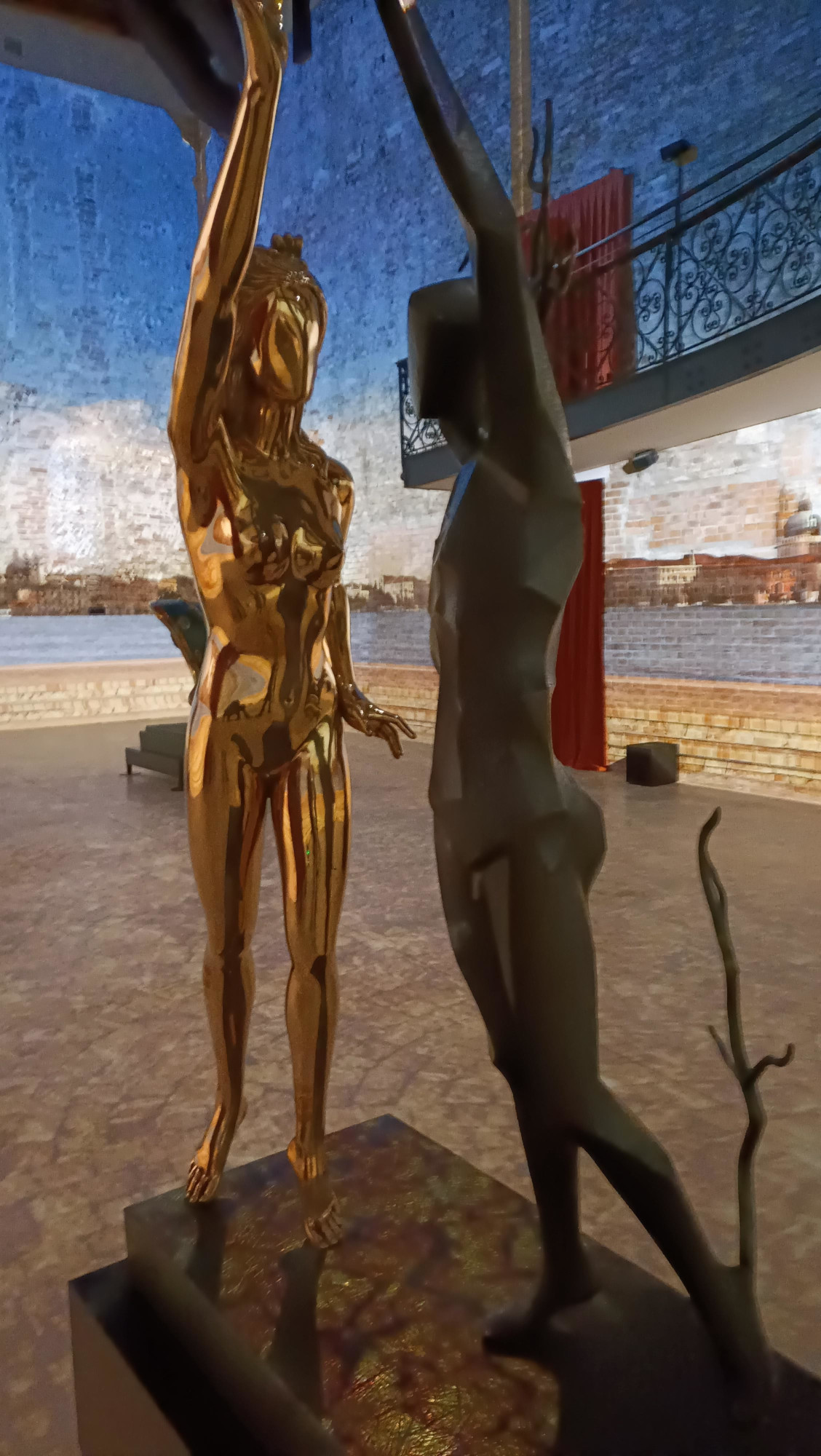
L’uso dell’esperienza immersiva (video, proiezioni, spazi che trasformano la percezione) non è del tutto nuovo per Bartoux: spiegazioni, anticipazioni parlano di realtà aumentata, virtual galleries, innovazioni similari. Ma la vera novità è come queste tecnologie siano integrate qui, nell’ex Cinema Accademia: l’altezza del soffitto, la grande volumetria, la storia dello spazio (cinema / teatro) rendono tutto perfetto per proiezioni immersive, suoni riverberanti, giochi fra luce e architettura.
✅ Risultato: un successo che promette continuità
L’inaugurazione è stata già segnata come una serata memorabile: ottima affluenza, entusiasmo vero, critica positiva. “Dalí è Venezia” non è solo una mostra, ma una promessa: che Bartoux abbia restituito alla città un luogo di cultura, ma anche di comunità, di gioia, di stupore. Che l’arte possa catturare non solo lo sguardo, ma il cuore. E che questa nuova casa dell’arte abbia già cominciato a vivere, a respirare, a emozionare.
Venice transforms into a surrealist dream: the Galeries Bartoux inaugurate the Gallerie Bartoux in the former Cinema Accademia!
Venice resurfaces in art: Galeries Bartoux, Dalí, and the former Cinema Accademia become magical
If you thought Venice had already shown all its wonders, prepare to be amazed. A new star has been born in the firmament of contemporary art: “Galeries Bartoux” has opened its first Italian location in the former Cinema Accademia in Dorsoduro—a place that for decades was the beating heart of Venetian arthouse cinema—and has transformed it into something epic, sensorial, and profoundly moving.
Who are Galeries Bartoux
For more than thirty years the Bartoux have been synonymous with aesthetic research, creative audacity, elegant spaces where art is not just to be looked at, but to be experienced. Founded by Robert & Isabelle Bartoux, founded in 1993, has expanded their global presence with galleries in Paris, London, Miami, New York, Monaco, and Singapore—all sharing the Bartoux style: a refined blend of established masters (sculptors, painters, and street artists) and emerging young talents. Bartoux isn’t just an exhibition: it’s an experience. Augmented reality, immersive spaces, and a dialogue between art, architecture, and design. Each gallery is a prestigious showcase but also a place of aesthetic romance.
Venice: the former Cinema Accademia as the stage for a dream
Imagine: a historic cinema, closed in 2002, with its seats, darkness, and retro charm, awakening in a new guise. The walls, the ceiling, the vaults—even the floor—now become immense, engaging canvases, capable of transporting the viewer into a dream. The former Cinema Accademia, open since 1928 and built on a 16th-century theater, has been restored with great attention to the past, but with a focus on the future. The space is approximately 1,200 m²: exhibition halls, a 500-square-meter immersive cinema about 12 meters high (so you can look up and feel “enveloped” by the story), a “Café des Arts” curated by Le Marcandole, and a private sculpture garden. The concept is called Bartoux Experience: art, design, technology, community, emotion.
Dalí is Venice: surrealism on display, immersion and enchantment
The star of the opening is Salvador Dalí. Bartoux collaborates with Dalí Universe to present the exhibition “Dalí is Venice.” It will feature a selection of sculptures, paintings, and lithographs by the master of Surrealism. But that’s not all: at the same time, the immersive cinema will be inaugurated with a new video production, entitled “A Serenissima as a Surreal Dream by Salvador Dalí.” An experience that isn’t limited to contemplation, but envelops the viewer, transforming them into protagonists. Dalí had real ties to Venice: he participated in the 1954 Biennale, created a poster for PiazZa San Marco in 1976, he painted “Othello rêvant de Venise” in 1982. These references make the homage “Dalí is Venice” not only beautiful, but touching, as if the city itself were called to dialogue with its visitor through surrealism.
🎶 Music, magic, crowd: a dream evening
And here comes the emotional heart of the event: the inauguration wasn’t just a simple ceremony, but a total experience. The venue was packed, a buzz in the air. On terraces or attics, elegantly dressed violinists soar to the music, inviting the ear to marry the sight, the skin, the breath. Imagine: sweet notes resonating while immersive projections envelop the walls, surreal figures coming to life, and the lagoon city reflected in every painting, every sculpture. The crowd? Dozens, hundreds, enthusiastic Venetians outside, curious passers-by, art lovers, families, influencers, and critics inside. A true success: applause, admiration, and amazed comments. All wrapped in lights, reflections, textures, and the sounds of violins that seemed suspended in the Venetian sky.
🌟 Technology already seen elsewhere, but reinvented in Venice
The use of immersive experiences (videos, projections, spaces that transform perception) is not entirely new to Bartoux: explanations and previews speak of augmented reality, virtual galleries, and similar innovations. But the real innovation is how these technologies are integrated here, in the former Cinema Accademia: the height of the ceiling, the large volume, the history of the space (cinema/theater) make everything perfect for immersive projections, reverberating sounds, and interplays of light and architecture.
✅ Result: a success that promises continuity
The inauguration has already been marked as a memorable evening: excellent A turnout, genuine enthusiasm, and positive reviews. “Dalí is Venice” isn’t just an exhibition, it’s a promise: that Bartoux has given the city a place of culture, but also of community, joy, and wonder. That art can capture not only the eye, but the heart. And that this new home of art has already begun to live, breathe, and excite.
Venise se transforme en rêve surréaliste : les Galeries Bartoux inaugurent la Gallerie Bartoux dans l’ancien Cinéma Accademia !
Venise refait surface dans l’art : les Galeries Bartoux, Dalí et l’ancien Cinéma Accademia deviennent magiques
Si vous pensiez que Venise avait déjà dévoilé toutes ses merveilles, préparez-vous à être émerveillé. Une nouvelle étoile est née au firmament de l’art contemporain : les Galeries Bartoux ont ouvert leur premier espace italien dans l’ancien Cinéma Accademia de Dorsoduro, un lieu qui fut pendant des décennies le cœur battant du cinéma d’art et d’essai vénitien, et l’ont transformé en un lieu épique, sensoriel et profondément émouvant.
Qui sont les Galeries Bartoux ?
Depuis plus de trente ans, la maison Bartoux est synonyme de recherche esthétique, d’audace créative et d’espaces élégants où l’art ne se contente pas d’être regardé, mais s’expérimente. Fondée par Robert & Fondée en 1993, Isabelle Bartoux a étendu sa présence internationale avec des galeries à Paris, Londres, Miami, New York, Monaco et Singapour, toutes partageant le style Bartoux : un mélange raffiné de maîtres reconnus (sculpteurs, peintres et street artistes) et de jeunes talents émergents. Bartoux n’est pas seulement une exposition : c’est une expérience. Réalité augmentée, espaces immersifs et dialogue entre art, architecture et design. Chaque galerie est une vitrine prestigieuse, mais aussi un lieu de romance esthétique.
Venise : l’ancien Cinéma Accademia, théâtre d’un rêve
Imaginez : un cinéma historique, fermé en 2002, avec ses fauteuils, son obscurité et son charme rétro, se réveille sous un nouveau jour. Les murs, le plafond, les voûtes, et même le sol, deviennent désormais d’immenses toiles captivantes, capables de transporter le spectateur dans un rêve. L’ancien Cinéma Accademia, ouvert depuis 1928 et construit sur un théâtre du XVIe siècle, a été restauré avec une grande attention portée au passé, mais avec une attention particulière portée à l’avenir. L’espace d’environ 1 200 m² comprend des salles d’exposition, un cinéma immersif de 500 m² à environ 12 mètres de hauteur (pour que vous puissiez lever les yeux et vous sentir enveloppé par l’histoire), un « Café des Arts » organisé par Le Marcandole, et un jardin de sculptures privé. Le concept s’appelle Bartoux Experience : art, design, technologie, communauté, émotion.
Dalí est Venise : le surréalisme exposé, immersion et enchantement
La star du vernissage est Salvador Dalí. Bartoux collabore avec Dalí Universe pour présenter l’exposition « Dalí is Venice ». Elle présentera une sélection de sculptures, de peintures et de lithographies du maître du surréalisme. Mais ce n’est pas tout : parallèlement, le cinéma immersif sera inauguré avec une nouvelle production vidéo intitulée « Une Sérénissime comme rêve surréaliste de Salvador Dalí ». Une expérience qui ne se limite pas à la contemplation, mais enveloppe le spectateur, le transformant en protagoniste. Dalí entretenait des liens étroits avec Venise : il a participé à la Biennale de 1954, créé une affiche pour la place Saint-Marc en 1976, peint « Othello rêvant de Veni » (Othello, le rêveur de Venise) la même année et créé « Le Secret de Venise ».Après avoir quitté San Marco en 1976, il peint « Othello rêvant de Venise » en 1982. Ces références rendent l’hommage « Dalí est Venise » non seulement beau, mais touchant, comme si la ville elle-même était appelée à dialoguer avec son visiteur à travers le surréalisme.
🎶 Musique, magie, foule : une soirée de rêve
Et voici le cœur émotionnel de l’événement : l’inauguration n’était pas une simple cérémonie, mais une expérience à part entière. La salle était pleine à craquer, l’ambiance était palpable. Sur les terrasses ou les greniers, des violonistes élégamment vêtus s’élancent au rythme de la musique, invitant l’oreille à épouser la vue, la peau, le souffle. Imaginez : de douces notes résonnent tandis que des projections immersives enveloppent les murs, des figures surréalistes prennent vie, et la ville lagunaire se reflète dans chaque tableau, chaque sculpture. La foule ? Des dizaines, des centaines : des Vénitiens enthousiastes à l’extérieur, des passants curieux, des amateurs d’art, des familles, des influenceurs et des critiques à l’intérieur. Un véritable succès : applaudissements, admiration et commentaires émerveillés. Le tout enveloppé de lumières, de reflets, de textures et du son des violons qui semblait suspendu dans le ciel vénitien.
🌟 Une technologie déjà vue ailleurs, mais réinventée à Venise
L’utilisation d’expériences immersives (vidéos, projections, espaces transformant la perception) n’est pas une nouveauté pour Bartoux : explications et aperçus évoquent la réalité augmentée, les galeries virtuelles et autres innovations similaires. Mais la véritable innovation réside dans la manière dont ces technologies sont intégrées ici, dans l’ancien Cinéma Accademia : la hauteur sous plafond, le volume important et l’histoire du lieu (cinéma/théâtre) se prêtent parfaitement aux projections immersives, aux sons réverbérants et aux jeux de lumière et d’architecture.
✅ Résultat : un succès qui promet la continuité
L’inauguration a déjà été marquée par une soirée mémorable : une excellente affluence, un enthousiasme sincère et des critiques positives. « Dalí est Venise » n’est pas seulement une exposition, c’est une promesse : Bartoux a offert à la ville un lieu de culture, mais aussi de convivialité, de joie et d’émerveillement. Que l’art puisse captiver non seulement les yeux, mais aussi le cœur. Et ce nouveau foyer de l’art a déjà commencé à vivre, à respirer et à s’animer.


 Diario di un operatore museale