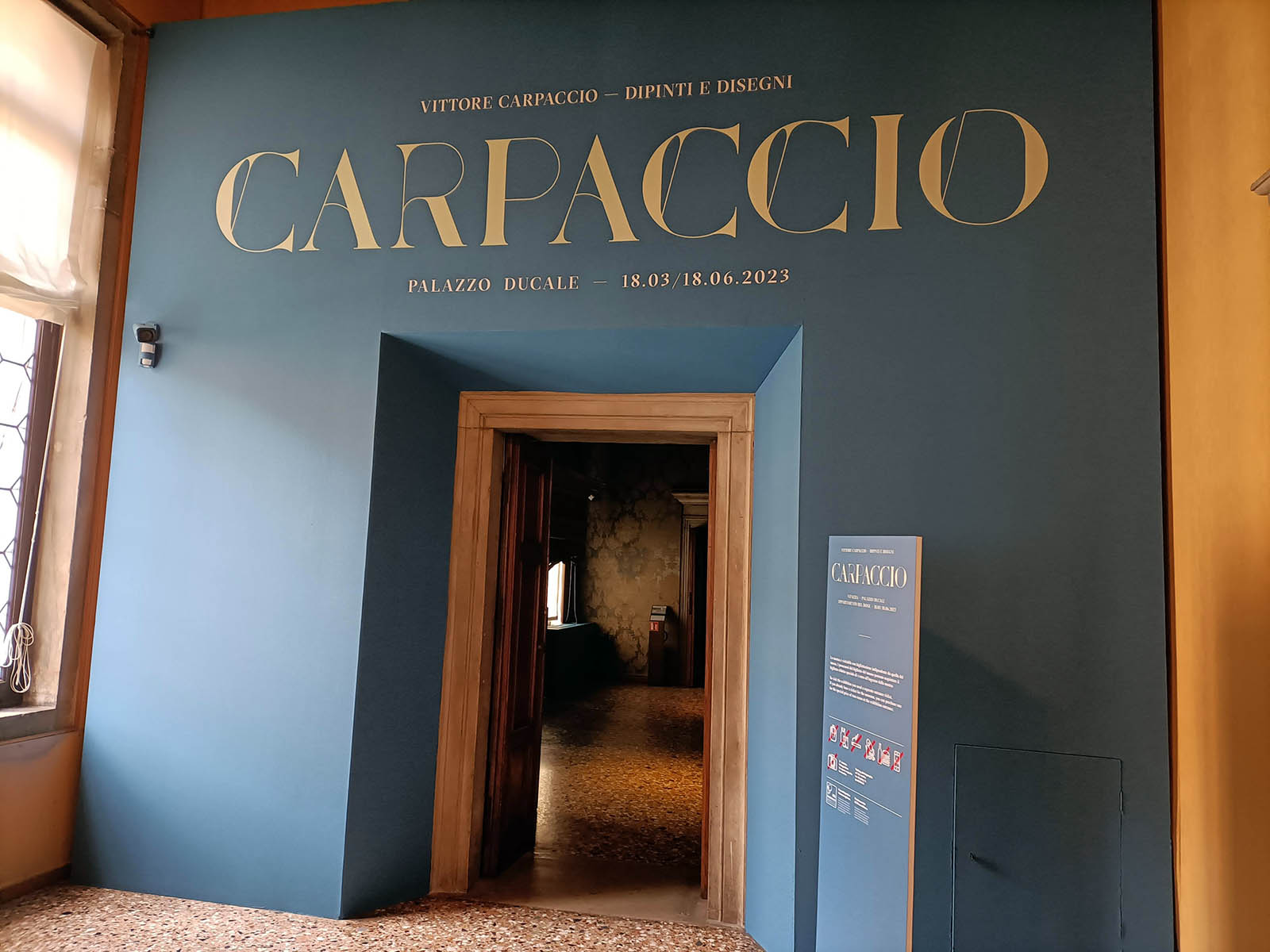
Mostra di Carpaccio a Palazzo Ducale

For the English translation please scroll down the page, thank you !

Questo articolo è privo di fotografie, in quanto vige all’interno della mostra il divieto di fotografare.

La mostra di Vittore Carpaccio, dopo aver visitato la National Gallery of Art of Washington, dove è stata visibile per parecchio tempo, finalmente approda a Venezia, grazie allo sforzo collettivo tra il museo sopra menzionato e la Fondazione di Musei Civici di Venezia, dove è stata aperta al pubblico il 18 marzo e finirà dopo pochi mesi, ovvero il 18 giugno. La mostra è stata collocata negli appartamenti del Doge, ed è visibile tutti i giorni nei consueti orari d’apertura del Palazzo (si prega di tenere conto del cambio d’orari che avverrà tra pochi giorni).

Per accedere alla mostra, bisogno salire sulla loggia, e ci si troverà al bivio, dove si salirà su per la scala d’oro, o nel giro turistico di Palazzo Ducale, o alla mostra. Dopo pochi scalini, si girà sulla destra, e subito compare l’entrata, dove ci verrà controllato il biglietto, e ci verranno illustrati le procedure adottate per la visita.

Vittore Carpaccio (Venezia, 1465 circa – Capodistria, 1525/1526), ​​è stato un pittore italiano, cittadino della Repubblica di Venezia. Fu uno dei protagonisti delle produzioni veneziane dei Teleri a cavallo tra Quattrocento e Cinquecento, e diventa forse il miglior testimone della vita, dei costumi e dell’aspetto straordinario della Serenissima in quegli anni.

In questa mostra, avremo modo di ammirare, non solo i suoi quadri, ma anche i disegni, opere che normalmente non possiamo vedere, perché vengono da musei di altri paesi, ecco perché raccomando a tutti, di andare a vedere questa mostra, questa è un’opportunità rara, da cogliere subito al volo !

Tra le sue opere più famose, possiamo vedere:

  • Cacciando in laguna
  • Le due dame
  • Il ritratto del Doge Leonardo Loredan
  • Salvator Mundi
  • Il Leone di S. Marco
  • San Giorno che uccide il drago
  • e tanti altri ancora.

Parliamo dell’ultimo quadro menzionato nella lista, (mi dispiace di non poter pubblicare la foto per farvi capire meglio la spiegazione): San Giorgio uccide il drago la leggenda narra che per placare un terribile drago, il cui alito velenoso avrebbe causato epidemie e morte, gli abitanti della città di Selene in Libia, dovevano sacrificargli una o due pecore ogni giorno. Dopo tanto tempo ormai le pecore scarseggiavano e i Seleniti sono costretti a servire al mostro, Giovani uomini o fanciulle, che vengono sorteggiati, prima tra i popolani, e poi tra i nobili. Un triste giorno, venne il turno della figlia del re e lui tentò di tutto per salvarla da una sorte crudele, offrendo oro ai suoi sudditi, argento e anche parte del regno, ma il popolo rifiutò, e la fanciulla in abito regale si recò allo stagno dove viveva il drago. San Giorgio, il cavaliere errante la incontrò in questo luogo desolato, piangendo da sola. Venuto a conoscenza di questa storia crudele, il santo le promise aiuto in nome di Cristo, e ben presto affrontò il drago con la sua lancia, ferendolo. Il santo non uccise subito il drago, ma lo portò nella città di Selene e lo legò alla cintura con la fascia della giovane principessa ormai salva, solo quando tutti gli abitanti si convertirono a Cristo, e furono battezzati, San Giorgio, uccide il drago, e riparte alla ricerca di nuove avventure.

Cerchiamo di analizzare il quadro: Il santo dai folti riccioli biondi, è vestito di una lucente armatura. Le sue gambe sono ben piantate nelle staffe. Il peso di tutto il suo corpo è concentrato in avanti. La vista del mostruoso drago, sembra non intimidire il santo, ma invece si nota, che il suo cavallo, ha la testa girata di lato, quasi non sopportasse di guardarlo. Lo scontro fra di loro sembra rappresentare l’eterna lotta tra il bene e il male. Nel cristianesimo, il drago come il serpente, è un simbolo del male, di Satana stesso, non è inusuale illustrare quindi San Giorgio o l’Arcangelo Michele distruggere i draghi, sin dalla antica mitologia greco-romana. E’ interessante notare, che in un altro contesto, il drago è associato non al male, ma al bene, infatti nell’antica Cina, il drago era associato ad nuvole nel cielo, eventi soprannaturali, che portano pioggia e fortuna. Viene anche associato / descritto per la nascita di Gaozu, uno dei più eminenti imperatori della Cina, fondatore della dinastia Han, nelle cronache storiche cinesi del I secolo a.C. I draghi fecero la loro comparsa anche nella cosmologia cinese, nei quattro punti cardinali, c’è il drago azzurro che indica l’est, mentre al centro c’è il drago giallo da cui deriva l’associazione con imperatore stesso, il drago è simbolo personale dell’imperatore, mentre per l’imperatrice è la fenice. Il drago corrisponde alla forza maschile Yang ed è spesso rappresentato insieme alla fenice come principio femminile ying, per indicare l’equilibrio.

Ritornando al nostro quadro, sulla destra, la figura della principessa in apprensione per l’imminente scontro. San Giorgio dopo aver sconfitto il malvagio drago, convince la principessa a legare l’animale con la sua cintura verginale, un gesto che sta a simboleggiare, la vittoria sul peccato e alla esaltazione della Cristiana virtù coniugale. La figura della principessa viene posizionata nel piccolo angolo sulla destra, in un atteggiamento, quasi religioso e/o di meditazione, mentre sullo sfondo dietro di lei, si intravedono simboli di salvezza, quali l’albero frondoso, il sentiero che conduce alla chiesa, e la nave con vele spiegate.

Nella parte bassa del quadro, ai piedi del drago, si osserva un suolo arido e petroso, disseminato dai macabri resti delle vittime del drago, teschi, ossa, corpi mutilati, e tutt’intorno si presenta un corteo di rettili, di ogni genere, come simbolo del male.

Potrei parlare ancora di questo quadro ma mi fermo qui. Magari nei prossimi articoli parlerò di qualche altro quadro presente nella mostra. Come ho detto sopra, questa è una mostra che presenta al pubblico delle opere a cui difficilmente si potrebbero vedere, per cui vale la pena, di andare a vedere. Unica nota dolente, è che non si possano assolutamente fare foto, nemmeno senza flash. Per cui spegnete il cellulare e godetevi la mostra !

Sito Ufficiale della mostra di Carpaccio a Palazzo Ducale

Exhibition of Vittorio Carpaccio at Palazzo Ducale

This article does not include photographs, as photography is prohibited within the exhibition.

The Vittore Carpaccio exhibition, after having visited the National Gallery of Art of Washington, where it was visible for a long time, finally arrives in Venice, thanks to the collective effort between the aforementioned museum and the Foundation of Civic Museums of Venice, where it is was opened to the public on 18 March and will end after a few months, i.e. on 18 June. The exhibition has been located in the Doge’s apartments, and can be seen every day during the usual opening hours of the Palace (please note the change in opening hours which will take place in a few days).

To access the exhibition, you need to go up to the “loggia”, and you will find yourself at the crossroads, where you will go up the golden staircase, either on the tour of the Doge’s Palace, or at the exhibition. After a few steps, turn right, and the entrance immediately appears, where the ticket will be checked, and the procedures chosen for the visit will be explained to us.

Vittore Carpaccio (Venice, circa 1465 – Capodistria, 1525/1526), ​​was an Italian painter, citizen of the Republic of Venice. He was one of the protagonists of the Venetian productions of the Teleri between the fifteenth and sixteenth centuries, and perhaps becomes the best witness to the life, customs and extraordinary appearance of the Serenissima in those years.

In this exhibition, we will be able to admire not only his paintings, but also his drawings, works that we normally cannot see, because they come from museums in other countries, that’s why I recommend everyone to go and see this exhibition, this is a rare opportunity, to be seized immediately!

Among his most famous works, we can see:

  • Hunting in the lagoon
  • The two ladies
  • The portrait of Doge Leonardo Loredan
  • Salvator Mundi
  • The Lion of St. Mark
  • St. George slaying the dragon
  • and many more.

Let’s talk about the last painting mentioned in the list, (I’m sorry I can’t publish the photo to make you understand the explanation better): St. George kills the dragon, legend has it that, to appease a terrible dragon, whose poisonous breath would cause epidemics and death, the inhabitants of the city of Selene in Libya, had to sacrifice one or two sheep to him every day. After a long time now the sheep were scarce and the Selenites were forced to serve the monster, young men or girls, who were drawn by lot, first among the common people, and then among the nobles. One sad day, the turn of the king’s daughter came and he tried everything to save her from a cruel fate, offering his subjects gold, silver and even part of the kingdom, but the people refused, and the girl in royal dress went to the pond where the dragon lived. Saint George, the knight errant met her in this desolate place, weeping alone. Having learned of this cruel story, the saint promised her help in the name of Christ, and soon faced the dragon with his spear, wounding him. The saint did not immediately kill the dragon, but brought it to the city of Selene and tied it to her belt with the sash of the now saved young princess, only when all the inhabitants converted to Christ and were baptized, Saint George kills the dragon, and sets off again in search of new adventures.

Let’s try to analyze the picture: The saint with thick blond curls is dressed in shiny armor. His legs are planted firmly in the stirrups. His entire body weight is focused forward. The sight of the monstrous dragon does not seem to intimidate the saint, but instead, we can see that his horse has its head turned to the side, as if it could not bear to look at him. The clash between them seems to represent the eternal struggle between good and evil. In Christianity, the dragon, like the serpent, is a symbol of evil, of Satan himself, so it is not unusual to illustrate Saint George or the Archangel Michael destroying dragons, since ancient Greek – Roman mythology. It is interesting to note that in another context, the dragon is associated not with evil, but with good, in fact in ancient China, the dragon was associated with clouds in the sky, supernatural events, which bring rain and luck. It is also associated / described for the birth of Gaozu, one of the most prominent emperors of China, founder of the Han dynasty, in the Chinese historical chronicles of the 1st century BC. Dragons also made their appearance in Chinese cosmology, in the four cardinal points, there is the blue dragon which indicates the east, while in the center there is the yellow dragon from which the association with the emperor himself, the dragon is personal symbol of the emperor, while for the empress it is the phoenix. The dragon corresponds to the male Yang force and is often represented together with the phoenix as the female ying principle, to indicate balance.

Returning to our picture, on the right, the figure of the princess apprehensive about the imminent clash. St. George after defeating the evil dragon, convinces the princess to tie the animal with her virginal belt, a gesture that symbolizes the victory over sin and the exaltation of Christian conjugal virtue. The figure of the princess is positioned in the small corner on the right, in an almost religious and/or meditative attitude, while in the background behind her, symbols of salvation can be glimpsed, such as the leafy tree, the path leading to the church and the ship with full sail.

In the lower part of the picture, at the feet of the dragon, we observe an arid and stony ground, scattered with the macabre remains of the victims of the dragon, skulls, bones, mutilated bodies, and all around there is a procession of reptiles of all kinds, as a symbol of evil .

I could still talk about this picture for hours no end but I’ll stop now. Maybe in the next articles I will talk about some other painting in the exhibition. As I said above, this is an exhibition that presents the public with works that are unlikely to be seen, so it is worth going to see. The only sore point is that you absolutely cannot take pictures, even without a flash. So turn off your cell phone and enjoy the show!

Official site of the Carpaccio exhibition at Palazzo Ducale

S. Valentino

carezzonico s.valentino copy.jpg

For the english version, please scroll down the page

E dopo Carnevale, ecco un’altra splendida occasione per voi tutti che venite a visitare Venezia ! Quale magnifica occasione di visitare una città romantica come Venezia, proprio nel giorno di S. Valentino ! E perché non farlo dentro ai Musei Civici ?

Una leggenda, dice che il ponte dei sospiri di Palazzo Ducale, è il ponte degli innamorati, ma purtroppo devo confessarvi che non è così. I sospiri non erano di innamorati , ma di condannati alle prigioni del Palazzo, e quando attraversavano il ponte, attraverso le inferiate, potevano vedere per l’ultima volta il mondo esterno, ecco il perché dei sospiri.

Ma leggenda a parte, tutta la città di Venezia è romantica e meta ideale per il vostro S. Valentino, e potete prendere due piccioni con una fava e visitare i magnifici Musei Civici ! Palazzo Ducale, Museo di Cà Rezzonico, Museo Correr, Palazzo Fortuny, Casa Goldoni, Palazzo Mocenigo, Museo di Cà Pesaro ! Sono tutte mete speciali per passare un week end (o più giorni) per le coppie innamorate.. Vi aspettiamo !!

S. Valentine’s day in Venice !

Valentine's day copy.jpg

And after the Carnival, you have another wonderful opportunity  to visit Venice! What a unique occasion to visit a romantic city like Venice, right in the Valentine’s Day! And why not do it visiting the beautiful Civic Museums?

A legend says that the bridge of sighs of the Doge’s Palace, is the bridge of lovers, but unfortunately I have to confess that it is not true! The sighs were not from men in love, but from the sentenced criminals to the prisons of the palace, when they crossed the bridge, through the bars, they could see for the last time the outside world, that’s why they sighed.

But legends aside, the whole city of Venice is romantic and ideal destination for your S.Valentine’s day and  you can kill two birds with one stone choosing to visit the magnificent Civic Museums while you are there! The Doge’s Palace, the Museum of Ca ‘Rezzonico, Correr Museum, Fortuny’s Palace, Goldoni’s House, Mocenigo’s Palace, the Museum of Cà Pesaro! They are all special places to spend a weekend (or more days) for couples in love .. Come, we will welcome all of you with open arms !!

Acqua e cibo nella storia di Venezia

Acqua e cibo nella storia di Venezia

(for the english version, please scroll down the page)

Questa volta vi voglio parlare, della mostra che si tiene a Palazzo Ducale a Venezia: “ACQUA E CIBO A VENEZIA. Storie della Laguna e della città”. E’ una mostra che si tiene negli appartamenti privati del Doge dal 26 settembre 2015 al 14 febbraio 2016. Una mostra che sembra collegata con l’ EXPO 2015 e il suo tema portante “Nutrire il Pianeta: energia per la Vita”, più che altro, semmai, è una mostra complementare, nel senso che offre un punto di vista totalmente insolito, in quanto Venezia è una città unica, particolare, e si differenzia da tutte le altre per quanto riguarda il suo territorio, e quindi i suoi modi di sostentamento.

La mostra offre ai visitatori un forte impatto tecnologico, in quanto le spiegazioni, gli approfondimenti, sono per la maggior parte interattivi per mezzo di televisori touch screen, proiettori 3d, modellini in scala, e narrazioni digitali, che vanno a complementarsi ai pannelli esplicativi bi lingue delle diverse aree.

  • La Laguna si trasforma
  • Acqua e cibo in laguna e terra ferma
  • Banchetti, feste, sagre, ect
  • L’architettura e l’alimentazione
  • L’approvvigionamento dell’acqua di una città particolare come Venezia

La prima area, come menzionato sopra, riguarda il cambiamento del territorio della laguna veneziana nel corso del tempo. La prima sala infatti ospita una serie di mappe che mostrano, come sia cambiato l’ambiente, le opere idrauliche fatte ad opera della Repubblica per lo sviluppo delle coltivazioni, della pesca e della produzione alimentare, per migliorare le vie di comunicazione da e per la terraferma, fondamentali luoghi di scambi e di distribuzione delle merci. Mappe di media grandezza appese al muro e di grandi dimensioni esposte in bacheca, sono molto interessanti e trovo la loro collocazione, assolutamente perfetta, in quanto la sala adiacente, non è altro che la sala delle mappe !

La seconda area è molto importante in quanto dà risalto ad alcune figure della Venezia di allora, quali: pescatori, frutaroli e pistori, che ritroviamo nei stupendi quadri di Pietro Longhi, alcuni dei quali provenienti dal secondo piano del stupendo museo di Cà Rezzonico, e anche presenti nel museo della casa di Carlo Goldoni. In un modo o nell’altro i musei della Fondazione sono uniti tra di loro e pertanto dopo aver visitato la mostra, si può benissimo visitare i due menzionati musei per un approfondimento. Tornando comunque alla mostra di Palazzo Ducale, ho trovato molto interessante, il fatto che un manoscritto antico, è stato riprodotto in digitale, in formato pdf penso, e lo si può studiare, muovendo le pagine avanti e dietro, come se fosse un vero libro, con un dito, come si fa con un ebook ! In questa maniera si possono salvare gli antichi documenti e studiarli a nostro piacimento in ogni luogo. Altro dipinto da menzionare: “La creazione degli animali ” di Jacopo Tintoretto, che offre una panoramica  della grande varietà di pesci ed uccelli presenti sul territorio anfibio veneziano.

La Terza area, è dedicata a feste, banchetti, sagre.. tutte occasioni di ritrovo dove si possono ammirare le varie pietanze che vengono consumate, al giorno d’oggi, viene da pensare alla festa del Redentore, ma in passato c’erano altre occasioni, come “la sagra di S. Marta” raffigurata da Gaspare Diziani.  Insomma si possono ammirare quadri di feste di gente comune, e di sontuosi banchetti come quello di Abigail e Nabal ad opera di Francesco Zugno e Francesco Battaglioli.  Inoltre potete trovare il disegno ad opera di Antonio Canaletto e Gianbatista Brustolon, della partenza del Doge sul bucintoro per la cerimonia dello sposalizio di Venezia col mare.

La quarta area: l’architettura e l’alimentazione, continua con la sezione dedicata all’architettura, mostrando i luoghi di raccolta e di distribuzione di generi alimentari quali gli ospedali, i monasteri,  e le osterie. In una piccola stanza, sul pavimento ci sono 3 modellini in scala dell’isola di S. Secondo, o isola di S. Erasmo, che illuminati da un proiettore sul soffitto mostra come sia cambiata nel corso della storia.

isola s.secondo

isola s.secondo2

La storia che ci propone il proiettore sull’isola di S. Secondo inizia intorno al 1034, Inizialmente l’isoletta fu chiamata Sant’Erasmo. Nel 1034 la famiglia Baffo vi costruì una chiesa e un convento di monache benedettine, poi nel 1533, al posto delle benedettine vi succedettero i frati domenicani. Dal 1569, a causa dell’incendio dell’Arsenale, la Serenissima decise di trasferire le polveriere in varie isole tra cui San Secondo. Nel 1576, fatti allontanare i religiosi, l’isola divenne lazzaretto per gli appestati e, al loro rientro, i domenicani dovettero riattare il monastero e riedificare la chiesa, che fu consacrata nel 1608. L’sola fù poi abbandonata nel 1797 a causa dell’occupazione francese, e successivamente nel 1806. Si sa che poi l’isola divenne presidio militare e e divenne una vera fortezza con tredici pezzi, due da 18, tre da 36, quattro da 24 e due obici da 8 e cinque mortai da 12, oltre a due cannoni da 6. Fu occupata durante l’occupazione Austriaca. Nel 1968 è stato ceduto in concessione, assieme a tutta l’isola, a dei privati e al giorno d’oggi essa risulta in stato di abbandono.

L’ultima area finisce con la sezione In mezzo all’acqua/senz’acqua”, dove si parla della difficoltà dell’approvigionamento di riserve d’acqua, che può sembrare strano in una città come Venezia, che è circondata dall’acqua!

Assolutamente non posso dimenticare le interviste da parte di noti studiosi, su alcune opere, a disposizione dei visitatori su un televisore touch screen, dove si possono scegliere i vari argomenti.

  • Il più bel quadro del mondo
  • Dame, laguna e simboli
  • Carpaccio e la pittura fiaminga
  • L’opera e i suoi enigmi
  • La laguna veneta e i casoni
  • Struttura dei casoni
  • I casoni oggi
  • I casoni dell’entroterra
  • Le vie lagunari
  • Caccia e pesca in laguna
  • Le campane in laguna
  • Barche Veneziane

Le prime quattro scelte, sono quelle che mi hanno attirato di più, dove si parla del famoso quadro, “Le dame Veneziane”del Carpaccio, che fino ad’ora ho pensato fosse uno, quando invece si è scoperto, che con un altro quadro scoperto da poco, messo sopra, completa l’opera.

Le dame veneziane Vittore_carpaccio,_caccia_in_laguna,_1490-1495_ca,_getty_museum Vittore_carpaccio,_due_dame_veneziane_e_caccia_in_laguna

Mostra molto interessante, ottima la scelta di collocazione dentro Palazzo Ducale, così la gente avrà un motivo in più per visitarlo, ma date retta al sottoscritto: quando guardate le opere, date un’occhiata ai cartellini esplicativi, oltre a vedere il titolo e il nome dell’artista, guardate anche la loro provenienza, questo magari vi inspirerà a visitare anche i musei che lo possiedono, e che offrono tante altre opere da ammirare.

English Version:

Food and Water in the lagoon through history of Venice

This time, I want to talk about, the exhibition held at the Doge’s Palace in Venice: “WATER AND FOOD IN VENICE”. Stories of the Lagoon and the city. It ‘a show that takes place in the private apartments of the Doge from 26 September 2015 to 14 February 2016. An exhibition that seems connected with the’ EXPO 2015 and its main theme “Feeding the Planet: Energy for Life” more than anything else If anything, it shows a complementary, in the sense that it offers a point of view totally unusual in that Venice is a unique city, particularly, and it differs from all others in terms of its territory, and therefore their livelihoods .

The exhibition offers to the visitors a strong technological impact, as explanations, insights, are for the most part by means of interactive touch screen televisions, projectors 3d, scale models, and digital narratives ranging in complement to the explanatory panels bi languages of the different areas.

  • The Laguna is transformed
  • Food and water in the lagoon and the mainland
  • Banquets, parties, festivals ect
  • The architecture and the power
  • The water supply of a particular city such as Venice

The first area, as mentioned above, concerns the change of the territory of the Venetian lagoon in the course of time. The first room it hosts a series of maps which show, as the environment has changed, the engineering work done at the hands of the Republic for the development of crops, fisheries and food production, to improve roads to and from the mainland, the fundamental places of exchange and distribution of goods. Maps of average size on the wall and large display on the bulletin board, are very interesting and I find their location, absolutely perfect, because the adjacent room, is nothing but the maps room!

 The second area is very important as it gives prominence to some figures of Venice of the time, such as fishermen, frutaroli, Pistori, that we find in the beautiful paintings by Pietro Longhi, some of whom came from the second floor of the beautiful museum Ca ‘Rezzonico, and they also can be seen at the museum of Carlo Goldoni’s house. In one way or another, the museums of the Foundation, they all are linked together, so after visiting the exhibition, you can  visit the two museums mentioned before for further discussion. Returning however to the exhibition at the Doge’s Palace, I found very interesting, the fact that an ancient manuscript, has been reproduced digitally in pdf format I think, and you can study, moving the pages back and forth, as if it were a real book , with a finger, as you do with an ebook! This way, you can save the ancient records and study them at will everywhere. Another painting by mentioning: “The Creation of the Animals” by Jacopo Tintoretto, which provides an overview of the wide variety of fish and birds in the area amphibious Venetian.

The third area is dedicated to parties, banquets, festivals .. all occasions of meeting place where you can admire the variety of foods that are consumed, nowadays, that make you to think of the Feast of the Redeemer, but in the past there were other occasions, such “the feast of St. Martha” represented by Gaspar Diziani. So you can admire paintings of parties with ordinary people, and sumptuous banquets like that of Abigail and Nabal by Francesco Zugno and Francesco Battaglioli. Also look for the design by Antonio Canaletto and Gianbatista Brustolon, the departure of the Doge on the bucintoro for the wedding ceremony of Venice with the sea.

The fourth area: the architecture and food, continues with the architecture section, showing the locations of collection and distribution of food such as hospitals, monasteries, and taverns. In a small room, on the floor there are 3 scale model of the island of S. Second, or island of St. Erasmus, who illuminated by a projector on the ceiling shows how it changed the course of history.

isola s.secondo2

isola s.secondo

The story that we hear, and see thank to  the projector, on the island of St second; According, starts around 1034, initially the island was called Erasmo, in 1034 the family Mustache built a church and a convent of Benedictine monks, then in 1533,  the Benedictines there succeeded by the Dominicans friars. From 1569, due to the fire of the Arsenal, the Venetian Republic decided to transfer the powder in various islands including St Second. In 1576, men were sent away, the island became a hospital for plague victims and, then the Dominicans friars  return, they had to rehabilitate and rebuild the monastery church, which was consecrated in 1608. The island was abandoned in 1797 because of ‘French occupation, and again in 1806. It is known that then the island became a military and and became a real fortress with thirteen pieces, two 18, three 36, four howitzers from 00:02 to 8:05 mortars 12, as well as two guns 6. It was occupied during the occupation of Austria. In 1968 he was given in concession, the private and nowadays it is abandoned.

The last area ends with “In the middle of the water / no water”, which speaks of the difficulty of Supply of water reserves, which may seem strange in a city like Venice, which is surrounded by water !

Absolutely, I can not forget the interviews by well-known experts about some of the works, available to visitors on a TV touch screen, where you can choose from the various topics.

  • The most beautiful picture in the world
  • Dame, lagoon and symbols
  • Carpaccio and painting fiaminga
  • The work and its enigmas
  • The Venetian lagoon and casoni
  • Structure of Casoni
  • The Casoni today
  • The Casoni hinterland
  • The streets lagoon
  • Hunting and fishing in the lagoon
  • The bells in the lagoon
  • Boats of Venice

The first four choices, are what attracted me more, where they talk about the famous painting, “The Venetian ladies” by Carpaccio, which until few time ago I thought it was only one, when in fact it turned out, that with  another picture, put on above, complete the work.

Vittore_carpaccio,_due_dame_veneziane_e_caccia_in_laguna Vittore_carpaccio,_caccia_in_laguna,_1490-1495_ca,_getty_museum Le dame veneziane


Very interesting exhibition, excellent choice of location inside the Doge’s Palace, so the people will have another reason to visit, but listen to myself: when you look at the works, take a look at the explanatory labels, in addition to seeing the title and artist name, look also their origin, maybe this will inspire you to visit the museums that own it, and they offer many other works to admire.