For the English translation please scroll down the page, thank you !
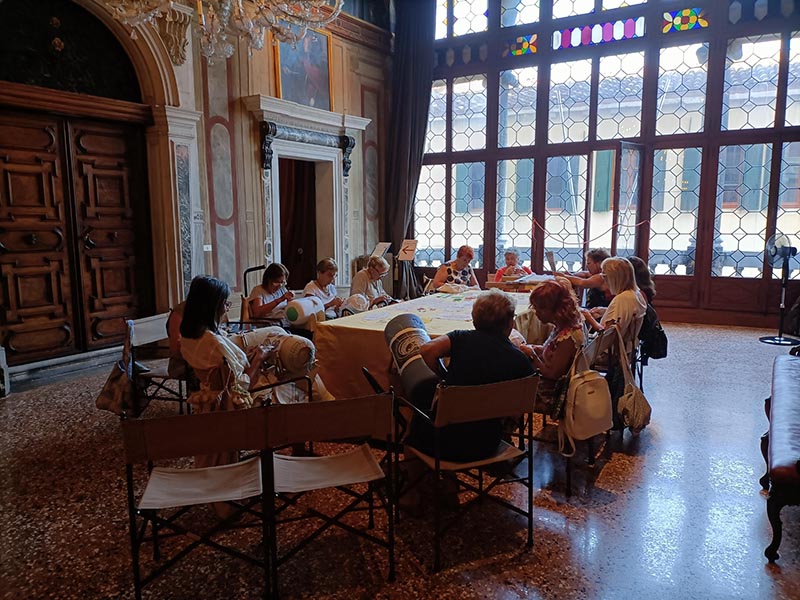
Nell’ambito del progetto “Fili di cuore”, riprendono “I venerdì a Museo di Palazzo Mocenigo” dalle 10.00 alle 12.00 che ospiterà i vari incontri del Merletto. Le maestre merlettaie di Burano e Pellestrina si alterneranno dimostrando il lavoro ad ago ea tombolo. Prossima data di luglio sarà Venerdì 21 luglio con l’ Associazione di Mestre “Sacolà e…ciacola ad ago” e il Venerdì 28 luglio con la ACS Murazzo di Pellestrina
Il merletto di Venezia è uno dei più famosi al mondo. È un’arte antica che ha avuto origine nel XVI secolo sull’isola di Burano, una delle isole della Laguna Veneta. Le prime testimonianze del merletto a Venezia risalgono al XVI secolo. In quel periodo, le monache veneziane iniziarono a ricamare merletti con ago e filo. Il merletto era un’attività molto popolare tra le donne veneziane, che lo usavano per decorare i loro vestiti e le loro case.
Nel XVII secolo, il merletto di Venezia iniziò a farsi conoscere in tutta Europa. Le merlettaie veneziane erano molto apprezzate per la loro abilità e la loro precisione. Il merletto di Venezia era un simbolo di ricchezza e di prestigio, e veniva indossato dalle donne più importanti dell’epoca. Nel XVIII secolo, il merletto di Venezia iniziò a perdere popolarità. Questo era dovuto a diversi fattori, tra cui l’arrivo di nuove tecniche di produzione del merletto, la Rivoluzione Francese e l’avvento della macchina da cucire.
Nonostante questo, il merletto di Venezia è ancora oggi un’arte molto apprezzata. È un simbolo della cultura veneziana e viene venduto in tutto il mondo. Le tecniche di lavorazione del merletto veneziano. Il merletto di Venezia viene lavorato con due tecniche principali: il punto a fuselli e il punto a tombolo. Il punto a fuselli è una tecnica che consiste nell’intrecciare i fili con gli aghi. Il punto a tombolo è una tecnica che consiste nell’intrecciare i fili con una macchina chiamata tombolo.
Il merletto di Venezia può essere lavorato con diversi tipi di filati, tra cui il cotone, la seta e l’oro. I merletti più antichi erano realizzati con fili di cotone o di seta. I merletti più recenti sono spesso realizzati con fili di oro o di argento. I merletti veneziani sono caratterizzati da motivi molto delicati e raffinati. I motivi più comuni sono i fiori, i frutti, gli animali e i simboli religiosi. I merletti veneziani vengono spesso utilizzati per decorare abiti, sciarpe, tovaglie, cuscini e altri oggetti. Sono anche molto apprezzati come oggetti da collezione.
Meetings with lace at Palazzo Mocenigo
As part of the “threads of the heart” project, “Fridays at Museo di Palazzo Mocenigo” from 10.00 until 12.00 am will resume, which will host the various meetings of the Merletto. The lace Mistress of Burano and Pellestrina will take turns demonstrating needle and pillow work. The next date in July will be Friday 21 July with the Mestre Association “Sacolà e…ciacola ad ago” and Friday 28 July with the ACS Murazzo di Pellestrina
Venetian lace is one of the most famous in the world. It is an ancient art that originated in the 16th century on the island of Burano, one of the islands of the Venetian Lagoon.The first evidence of lace in Venice dates back to the 16th century. At that time, Venetian nuns began to embroider lace with needle and thread. Lace was a very popular activity among Venetian women, who used it to decorate their clothes and their homes.
In the 17th century, Venetian lace began to become known throughout Europe. Venetian lacemakers were highly appreciated for their skill and precision. Venetian lace was a symbol of wealth and prestige, and was worn by the most important women of the time. In the 18th century, Venetian lace began to lose popularity. This was due to a number of factors, including the arrival of new lace-making techniques, the French Revolution, and the advent of the sewing machine.
Despite this, Venetian lace is still a highly appreciated art today. It is a symbol of Venetian culture and is sold all over the world. The Techniques of Venetian Lace Venetian lace is made with two main techniques: the bobbin lace and the pillow lace. Bobbin lace is a technique that consists of intertwining the threads with needles. Pillow lace is a technique that consists of intertwining the threads with a machine called a pillow.
Venetian lace can be made with different types of yarn, including cotton, silk, and gold. The oldest laces were made with cotton or silk threads. The most recent laces are often made with gold or silver threads.
The Patterns of Venetian Lace Venetian lace is characterized by very delicate and refined patterns. The most common patterns are flowers, fruits, animals, and religious symbols. Venetian lace is often used to decorate clothes, scarves, tablecloths, pillows, and other objects. They are also highly appreciated as collectible items.
 Diario di un operatore museale